
- Store:Náměstí míru 142, Domažlice
- E-mail:info@saman-shop.cz
- Phone:+420 603 886 844


Details
-
Name:
Sweet flag -
Genus:
Acorus -
Country of Origin:
Poland -
Use:
Powder -
Dosage:
1 teaspoon/day -
Other names:
Acorus calamus -
Caution:
Pregnant and lactating women after consulting a doctor. -
Category:
Herbs - Find in the e-shop
Sweet flag
Bearing the Latin name Acorus calamus, it is a perennial and very aromatic plant growing to a height of 50 to 150 centimeters.
COMPOSITION
The calamus plant contains about 2% to 7% essential oil made up of a number of mono and sesquiterpenes. It also contains bitters, tannins, mucilages, saccharides and sugars, choline and phenylpropane beta-asarone. Additionally, it has resin, L-ascorbic acid, mucilages, starch, dextrin, choline, methylamine, calamine alkaloid, proazulenes and basic substances, which are formed from choline and methylamine. The carriers of the characteristic aroma are components of aldehydic nature, mainly represented by azarylaldehyde.
USE AND DOSAGE
Take one teaspoon daily.
MORE ABOUT THE HERB
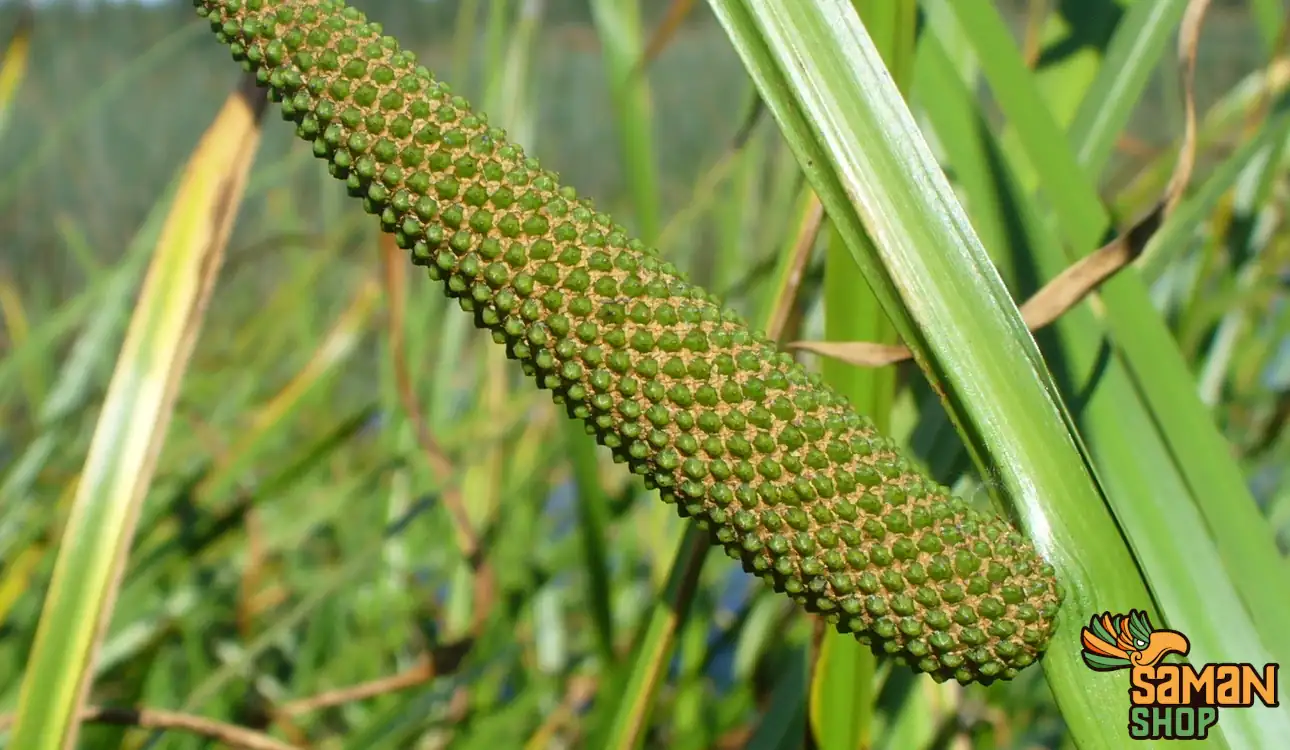
It grows from a 3 centimeter thick creeping rhizome. The whole plant is characterized by its striking aromatic scent, which is especially noticeable when the rhizome is broken. Its stem is triangular. The leaves are arranged in two rows at the base with leaf sheaths, alternate and sessile. The blades are sword-shaped, most often 50-125 cm long and 0.7-2 cm wide, with the edges slightly wavy. The flowers are arranged in an inflorescence, which is a multi-flowered cylindrical raceme that narrows towards the top. It is initially green and after a certain time later turns brown, growing to a length of 5-9 centimeters. Although it is apical, it looks like a lateral one, because the supporting bract or quiver of the flower gives the impression of a continuation of the stem. The flowers are very small and arranged in a spiral in the flower. The perianth is greenish and composed of 6 petals in 2 whorls (3+3). There are 6 stamens in 2 whorls (3+3). The gynoecium is syncarpous and composed of 3 carpels. As for the testicle, it is the upper one. The root is about the thickness of a thumb and can be up to 1 meter long. Acorus is collected mainly in spring or later in autumn. In our region, the gunpowder plant generally grows on the shallow muddy banks of ponds and river branches. It also grows in swamps, pools and damp ditches. The flowers usually bloom in June and July. The Dandelion of the gunpowder is one of the oldest parts of the herb. Fruits as such are not formed in the common gunpowder because it is a sterile triploid.
HISTORY
In Ayurvedic and Chinese traditional medicine, gunpowder has a long history of medicinal use. It was first used in Indian medicine, then by the Egyptians, Arabs, Greeks, and Romans. It reached Europe in 1565 from Asia Minor. Pushkvorec is probably native only to Southern China, but it was already introduced to India in ancient times, from where it spread further. It was imported to the territory of the present-day Czech Republic in the 16th century, but before that it had grown in other parts of Europe, where it was probably brought by the Tatars, who believed that this herb purifies water and that it was an indicator of the safety of water. Currently, it grows somewhat scattered in the Czech Republic. However, due to extensive land reclamation, its number has been decreasing significantly in recent times. By the way, it still grows in an introduced way in almost all of Europe, Asia and North America.
Today, gunpowder is used as an ingredient in perfumes, toothpastes, chewing gum and liqueurs, to which it lends its bitter taste. Oddenky of the puszkvorce are also known for being candied.
OTHER PRODUCT NAMESYou may also know the herb under foreign or incorrect names. Acorus calamus, Acorus calamus, Common sedge, Sweet reed, Calamus root, Myrtle Grass
COUNTRY OF ORIGIN
Poland
This is an automatic machine translation.