
- Store:Náměstí míru 142, Domažlice
- E-mail:info@saman-shop.cz
- Phone:+420 603 886 844


Details
-
Name:
Chaga -
Genus:
Inonotus -
Country of Origin:
China -
Use:
Powder, capsule -
Dosage:
1 capsule/day -
Other names:
Chaga -
Caution:
Pregnant women after consulting a doctor -
Category:
Mushrooms - Find in the e-shop
Chaga
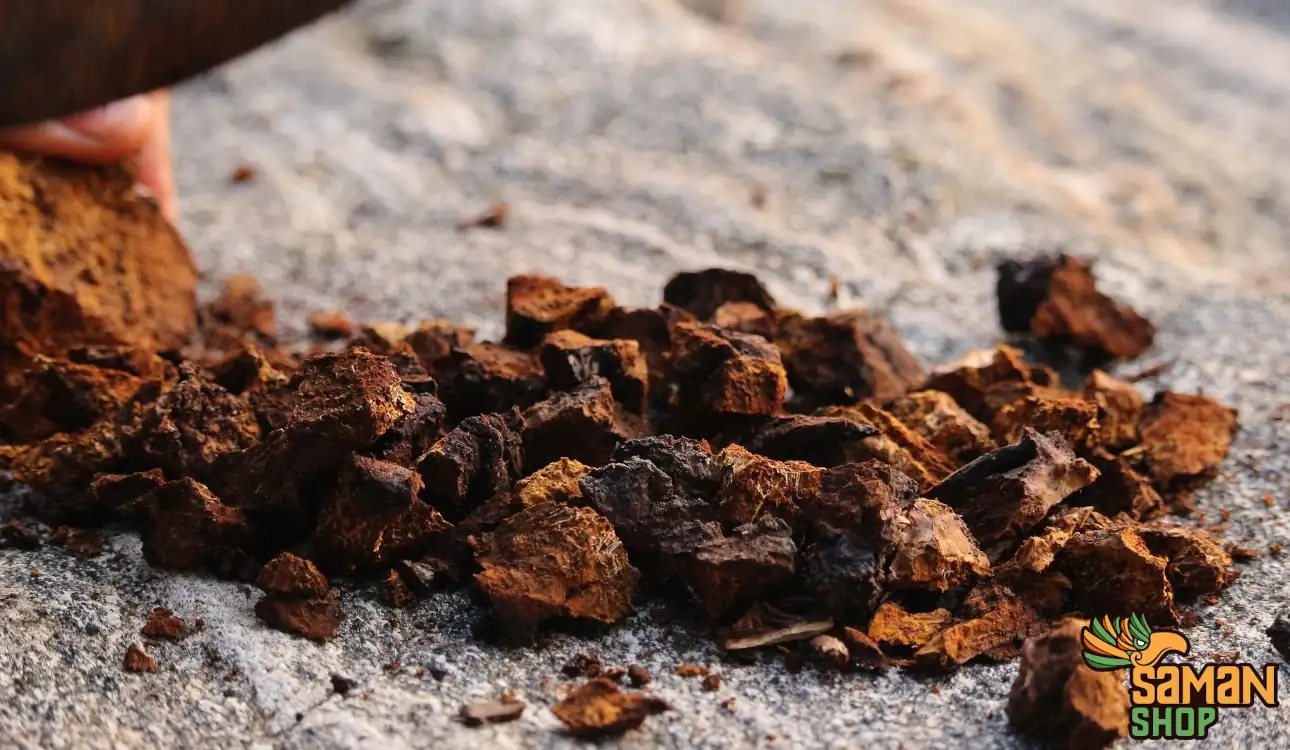
Siberian Chaga, Chaga mushroom, Inonotus obliquus or Inonotus obliquus are different names for the same mushroom. It can be found in the colder regions of northern Asia and Europe. And as the name suggests, it thrives especially well in Siberia. The occurrence of Chaga in the Czech Republic is not a complete rarity either.
Chaga is a perennial wood-decaying mushroom with a relatively unmistakable black color on the surface, which it acquired thanks to the high content of the pigment melanin. It grows under the bark of deciduous trees, most often found on birch trees. It enters the tree through wounds and can grow there unnoticed for decades. Over time, it grows through the entire trunk and its fruit bodies, from which we obtain the valuable extract, can grow up to several meters in size. They only begin to form when the tree begins to die and the mycelium is found almost throughout the entire trunk. The fungus forms two types of fruit bodies - perfect and imperfect. One-year perfect fruit bodies occur only from July to November and are much larger than multi-year imperfect ones, which grow to a maximum of 50 cm.
In the northern regions of China, Chaga was known to the inhabitants several thousand years ago, and you can also find mentions of it in Mesopotamia. Gradually, its popularity spread to the regions of Siberia and the Urals, where tea was prepared from the mushroom for shamanic rituals and for daily drinking. Over time, the mushroom found its way to the rest of the world and its popularity has skyrocketed in recent years. There is no longer any need to prepare tea, just take a capsule with an extract of this unique mushroom daily and wash it down with a glass of water.
The composition of this relatively rare mushroom is very interesting. You would find about 200 different biologically active substances in it. The most abundant are polysaccharides, led by beta-glucans and heteroglucans. Also worth noting are the polyphenolic substances and triterpenoids contained in it, such as inotodiol, obliquol, betulin and betulinic acid. The last two components are obtained by the fungus only from its host tree - birch. That is why Chaga growing on birch trees is the most valued. You will also find sterols, lipids, alkaloids and a whole range of other substances, the health effects of which are still being studied by science.
The fungus also contains a number of minerals such as magnesium, sodium, calcium, iron, copper, zinc, manganese or germanium. It also contains vitamin D and B vitamins.
USE AND DOSAGE
Take 1 to 2 Chaga capsules daily with a glass of water. If you have trouble swallowing capsules, try this simple trick: separate the capsule parts and mix the powder in water or a smoothie. You can also add the powder to various porridges. After 4 weeks of use, take a 1-week break, or after 3 months of use, take a 1-month break.
SIDE EFFECTS
There are no known side effects of Chaga, but discuss its use with your doctor if you are pregnant, breastfeeding, or have any health problems.
OTHER PRODUCT NAMES
You may also know the herb under foreign or incorrect names. Chaga, Siberian chaga, Inonotus obliquus, Oblique rustling
COUNTRY OF ORIGIN
China
This is an automatic machine translation.